Mother Cabrini
Patron Saint of Immigrants
7/15/1850 to 12/22/1917
When I was a little girl, we made the six-hour and twenty-five-minute drive to the Mother Cabrini Shrine in Golden, Colorado. At the time, I did not know much about Mother Cabrini, but I enjoyed visiting her shrine. I used to love climbing the three hundred, seventy-three steps leading up to the top of the Mount of the Sacred Heart. The scenery surrounding the shrine was beautiful and refreshing. Though I have not been to the shrine in more than twenty years, I still remember the peaceful, happy feeling of visiting the Mother Cabrini shrine.
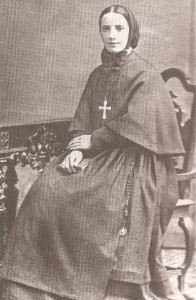
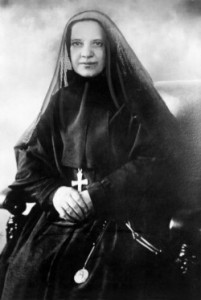
Born Maria Francesca Cabrini, Saint Frances Xavier Cabrini was born two months premature and the youngest of thirteen children, of whom only four survived beyond adolescence. She was said to be of ill and fragile health throughout her life. Yet, even as a young child, Saint Frances Xavier Cabrini wanted to be a missionary to China. One story tells of a young Saint Frances Xavier Cabrini creating paper boats with flowers as missionaries. She would set the boats, their flowers tucked inside, in the water to sail to China and India. Another story tells of Mother Cabrini falling into the water as she was setting off her paper boats. From that day forward, she was said to be terrified of the water.
Mother Cabrini was educated in the convent. She graduated magna cum laude with a teaching certificate at the age of eighteen. Later, she returned to the same convent to apply to be a nun but was refused admission due to her fragile health. Instead, she set to work teaching at an orphanage, where she drew a small number of women to live a religious lifestyle. Together, they founded the Missionary Sisters of the Sacred Heart. Seven years later, she professed her vows and become a nun.
As a nun, Mother Cabrini traveled to Rome to seek the Pope’s approval to travel to China as a missionary. Instead, the Pope sent her to New York to help the struggling Italians. Throughout the United States, she founded orphanages, schools and hospitals. She also established institutions in Central and South America. Though she was terrified of the water, during her lifetime, she made more than sixty trans-Atlantic voyages.
Mother Cabrini also visited prisoners. On one of her visits to Sing Sing prison, a prisoner, who was scheduled to be executed, told Mother Cabrini that he was innocent and falsely accused of murder. Though he had been appointed an attorney, the attorney did not believe him. Mother Cabrini is said to have found new evidence that re-opened his trial. The man was later released from prison. Another story tells of the nuns arranging for a prisoner’s mother to be brought from Italy to see her son before he was executed. After his execution, the nuns took care of the prisoner’s mother.
A less known miracle performed during her lifetime, concerns one of the nuns who lived and worked with Mother Cabrini. The nun suffered from varicose veins. She said she was relieved of her suffering simply by wearing Mother Cabrini’s stockings. Mother Cabrini doubted this and told the nun she was relieved of suffering by her own faith and prayers. At an orphanage in New York, where the only source of water was the Hudson River, Mother Cabrini prayed as the other nuns dug for water. They reached a fresh spring of water. A similar account is told at the Mother Cabrini shrine in Golden, Colorado. There, too, the only source of water was a stream at the bottom of a hill. The nuns complained of dire thirst to Mother Cabrini. Mother Cabrini pointed to a rock and told them to dig under the rock. There, too, they found a fresh spring of water. The spring of water at the Mother Cabrini shrine in Golden, Colorado is said to have healing properties.
After her death, Mother Cabrini is said to have healed a baby blinded by silver nitrate through her intersession. On another occasion, also after her death, Mother Cabrini is said to have healed a terminally ill nun. The nun had been sick for ten years. Mother Cabrini appeared to the nun in a dream and told her to arise because she had been healed through her (Mother Cabrini’s) appeal to the Sacred Heart of Jesus. After three days of not talking, the nun got up and asked for something to eat. She was healed.
Mother Cabrini became a naturalized U.S. citizen in 1909 and died in 1917. She was buried in New York. In 1933 her body was exhumed. Her head was sent to Rome for preservation, one of her arms is in Chicago, and the rest of her body is in New York. In 1938, she was beatified by Pope Pius XI. In 1946, she was canonized by Pope Pius XII. In 1950, she was named the Patron Saint of Immigrants. Her feast day is celebrated on December 22nd, the anniversary of her death; however, because of advent, in the U.S., her feast day is celebrated on November 13th, the anniversary of her beatification.


 melgal's blog